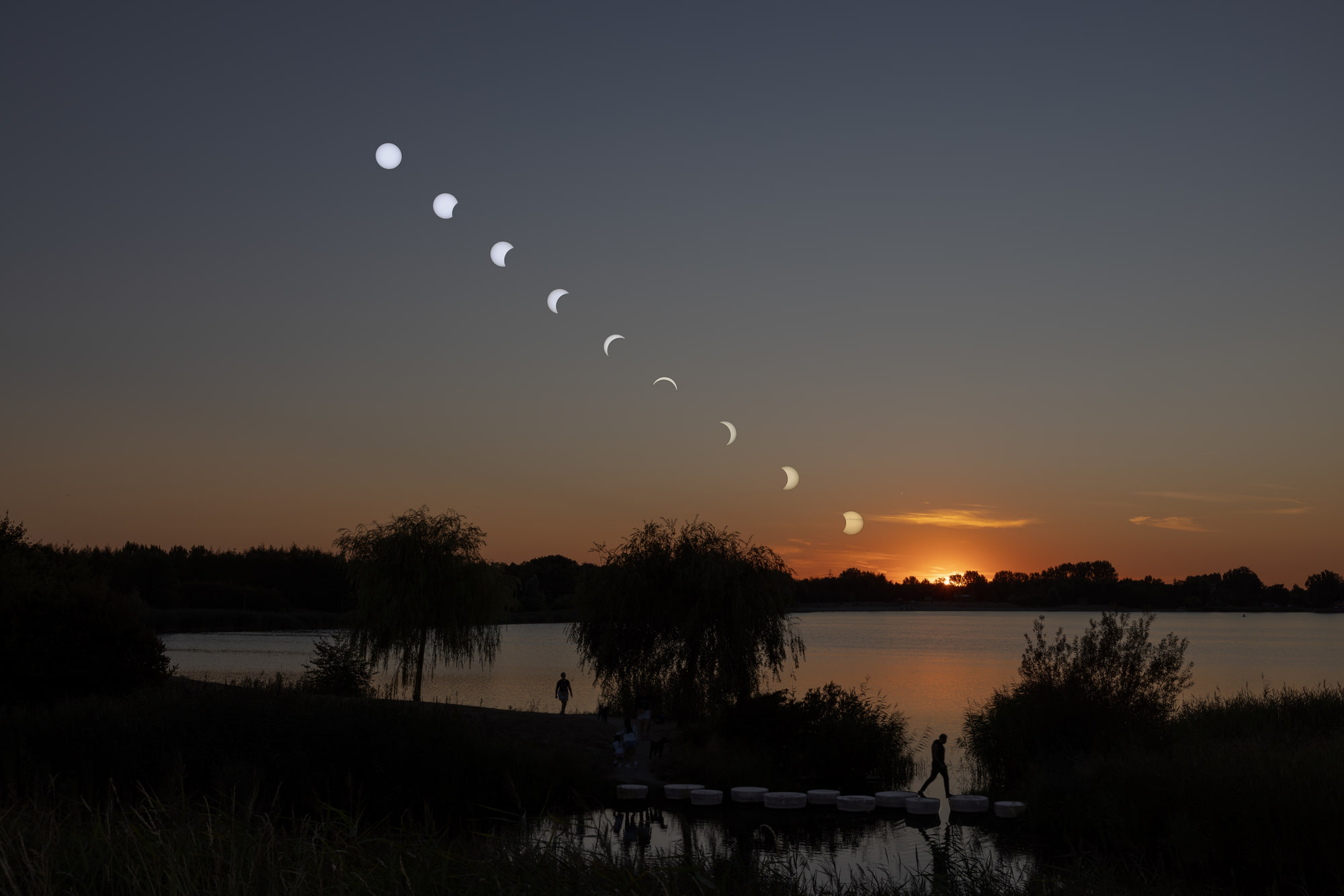
On 12 August 2026 the moon slid across the setting sun above the Toolenburgerplas.
I photographed from before first contact until the sun sank behind the tree line at 21:02, from a tripod I did not touch in between. The sequence starts at 19:16; at maximum, 20:11, 87.9 percent of the solar disc had gone.
Four minutes after the last light a man crossed the stepping stones, without looking up. The eclipse was over by then. In this image they go together; in reality minutes separated them.
A chain of suns above the water, a chain of stones below it. I did not invent that rhyme, it was there.
Three of these stepping stone crossings lie close together at the Toolenburgerplas. One of them lies under snow in the hall Winter.
Method
My work is made by waiting. Here that is impossible. An eclipse lasts almost two hours and no single moment shows the whole progression. And as long as the solar filter sits on the lens the camera records only the disc of the sun: everything else goes black. Sun and landscape do not fit in one frame. So I photographed everything that evening and joined thirteen frames into one image, each in its measured place, from the same tripod. Nothing was drawn in.
For the sun that was a necessity. For the foreground it was a choice: one landscape was assembled from four frames spanning 44 seconds, and in doing so a walker was moved in and two people were taken out. The first is measurable, the second is a compositional decision. I name them separately, because they are not the same thing.